Blog
Pre-digital era nostalgia
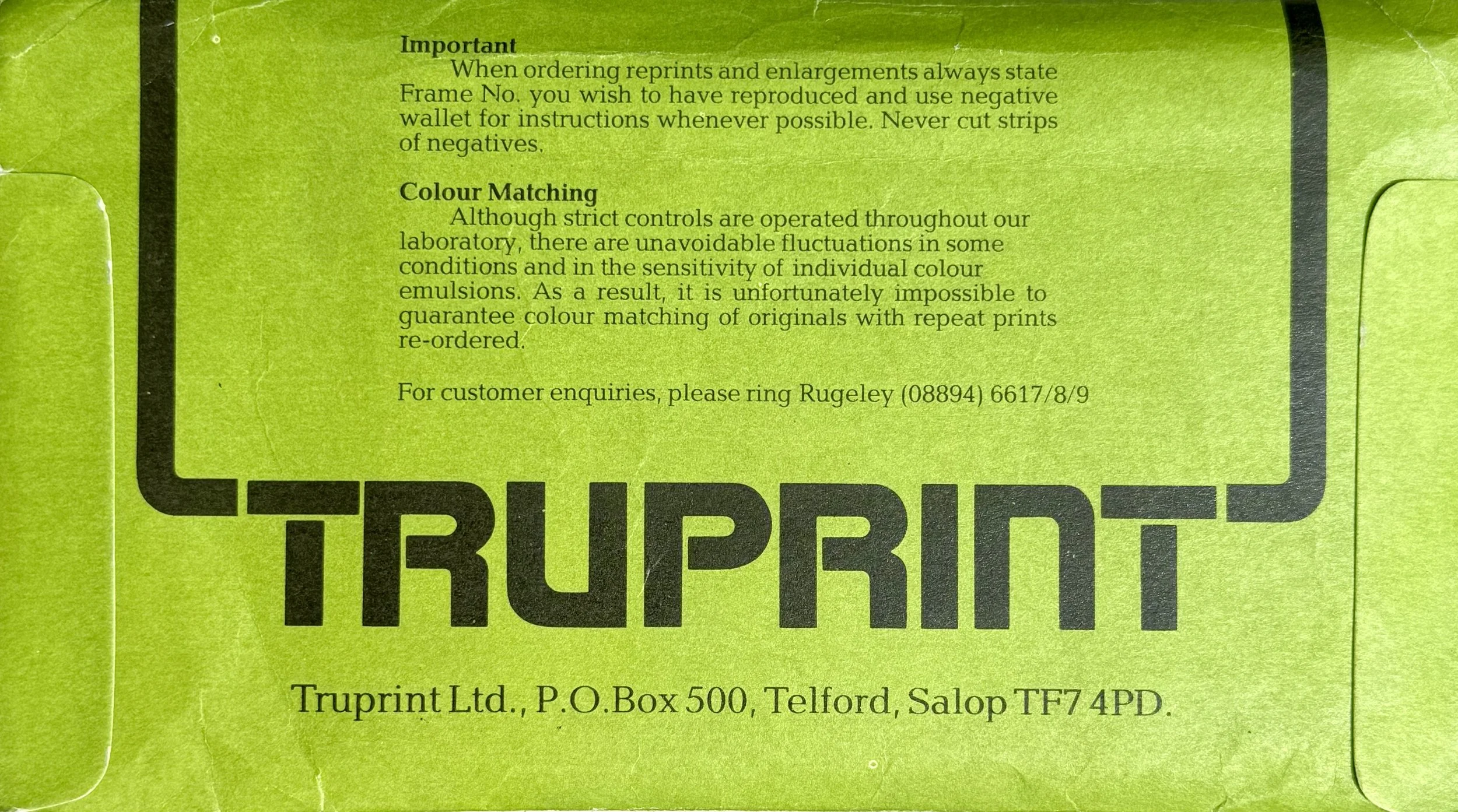
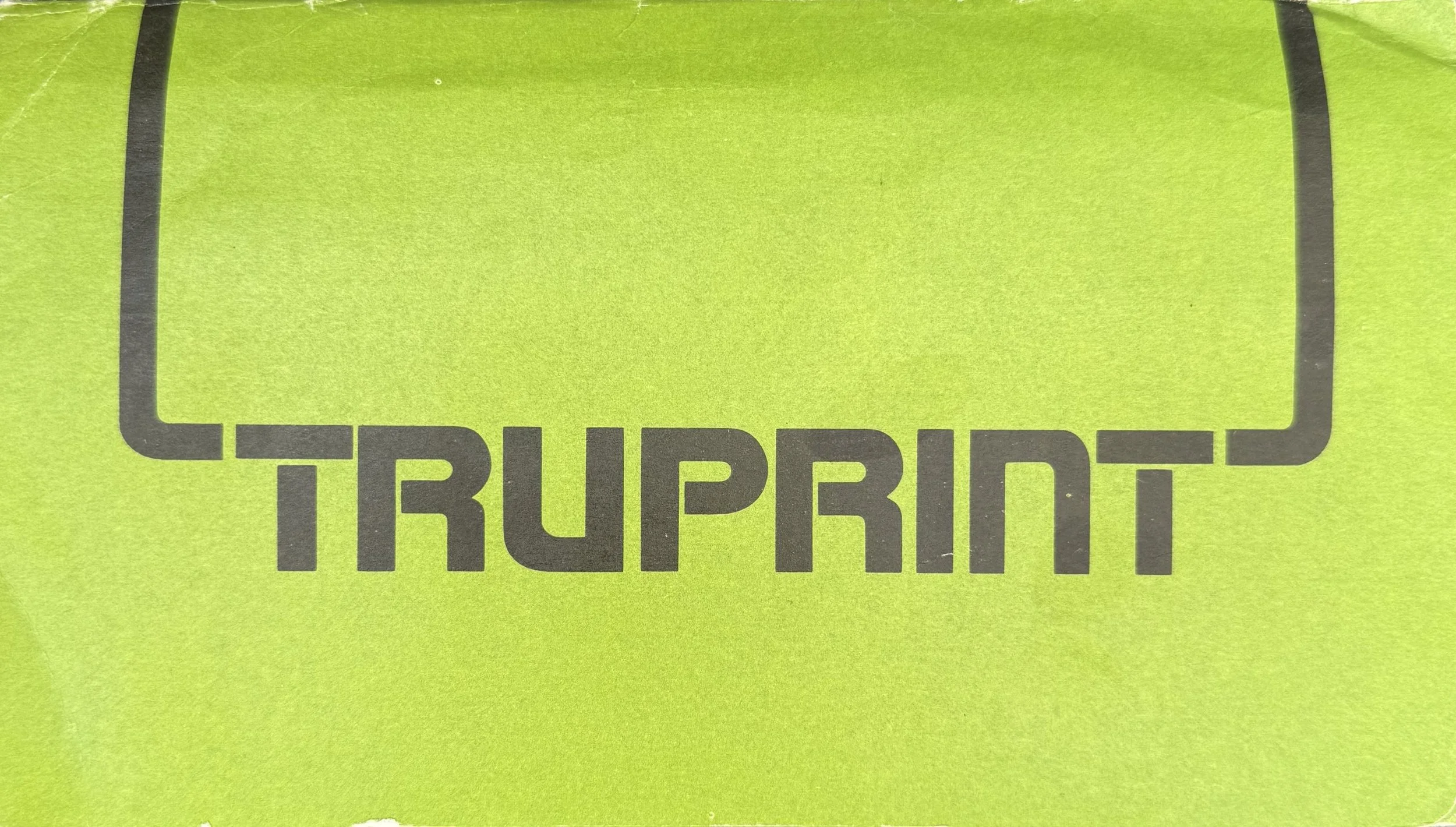
This month’s find is a stylishly simple 1980s TRUPRINT, in-house design, photo wallet. The design has a bit of an 80s video game or film title vibe, with the stereo bold lines and capitalised text. It stands out, in its simplicity, before the better known and more lurid multi-coloured turquoise wallets that followed.
TRUPRINT were big innovators of the photo print era and in the 1980s, long before digital cameras, they undercut high street prices and became the largest direct postal film processing company. In the heyday of film, and compact camera ownership, if you had a 35mm or 110 film camera you could use their service.
Many of us would have used a handful of films each year of typically 24 or 36 exposures (which didn’t feel particularly limiting at the time), then posted them to the lab, to wait in anticipation of receiving the photos back in the mail, in a stylish wallet, along with the negatives and a free roll of film!
The back design has an old dialling code on, showing its 80s vintage, and before ‘PHONEDAY’ (Sunday April 16th, 1995), when, after years of a public campaign, the U.K. introduced ‘01’ phone numbers and some entirely new area codes, as the country was running out of unique telephone numbers for the growing population.
July 2026
Back to the 90s?
This month, I’m joining the current nostalgia for the 90s and the 35mm film revival, popular with students and Gen Z.
A time before smartphones, when you could own a camera with no filters and no complex settings, where you could attempt to capture the ‘occasional chaos of real life on 35mm film’ (Dutchthrift) without overthinking it.
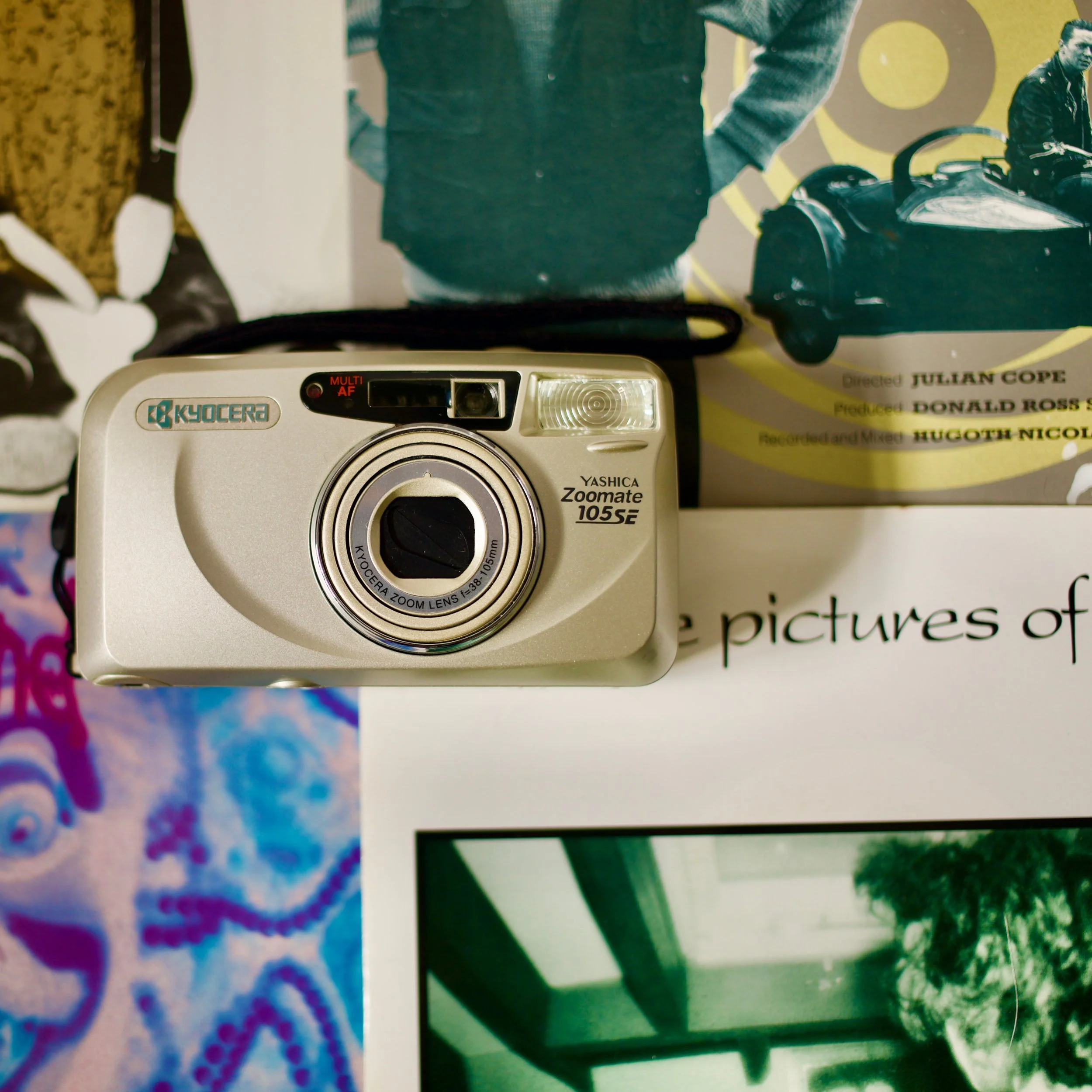
Kyocera (Japanese) launched a number of automatic compact cameras in the 90s, (previously a ceramics company, interestingly), at a time when my vinyl collection was most definitely stalling, being overshadowed by the CD take-over. However, fast forward to 2019 and suddenly vinyl sales peak again and in recent years interest in late 90s and early 2000 ‘point-and-shoot’ cameras, both film and early digital, has become really big. The simplicity appeals. Perhaps they offer a calmer, slower activity for the digital generation, with less fixation on control.
Perhaps now is the time to take out my old formerly retired Kyocera, to capture some of that chaos of real life? I think it prefers a 200-400 film, having a tendency for slightly dark images, but let’s find out!
May 2026
The 1950s Minox spy camera
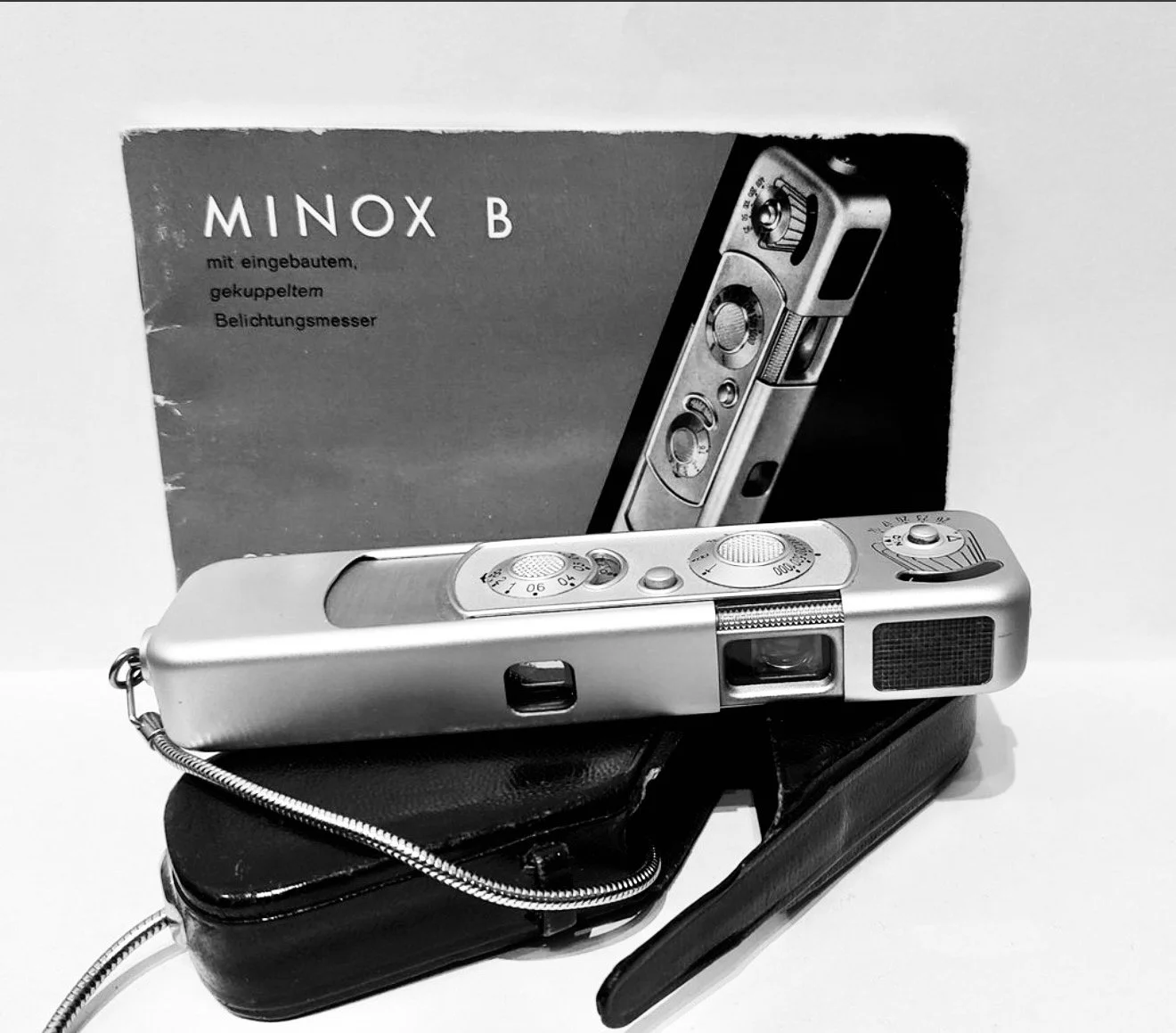
This month, in my hunt for Golden Age and later crime fiction novels with a photography link, I’ve stumbled across an author I’ve not read before, the late Helen Dunmore. Exposure (2016, Windmill Books) is set after the second world war and into 1960. It briefly references the Minox spy camera, invented in 1936 by Walter Zapp in Wetzlar, Germany. It was used after 1945 by both East and West German intelligence agencies as well as British intelligence.
‘He got out his Minox and his measuring chain and photographed trivia for other trivial men to look at in offices God knows where.’ These ‘spy cameras’ were smaller than a cigar. The novel plays close to home and family, with a subtle Cold War era theme of surveillance and uncertainty. There is also the ever present tension and risk of exposure, in more ways than one, due to the societal taboos and laws of the time.
April 2026

Answer in the Negative, Henrietta Hamilton
This month, I am hunting Golden Age and later crime fiction novels with a photography link.
My current read is the 1959 Answer in the Negative (2026 imprint, Penguin/The Mermaid Collection), with an affectionate foreword by Sophie Hannah (Hannah’s Poirot novels, written at the request of Agatha Christie’s family and estate, are also excellent atmospheric fun). The tale features glass photographic negatives, in use during the 1950s in the Fleet Street newspaper offices and nearby photography archives. They would have been quite the sight, stored en masse, but also quite the weight. No spoilers!
Answer in the Negative has some old-fashioned amateur surveillance, as we are in the time before mass ownership of cameras or the invention of CCTV, so it feels rather innocent; however, it would have carried grave consequences if you were caught.
On glass slides in the novel, it seems that for the period - the 1950s - it might have been a mix of dry gelatin plates (1870s-1920s) and Lanton glass slides (1850s -1950s), but as yet there isn’t much detail about the slides, other than they are glass. I shall leave you to read it!
April 2026
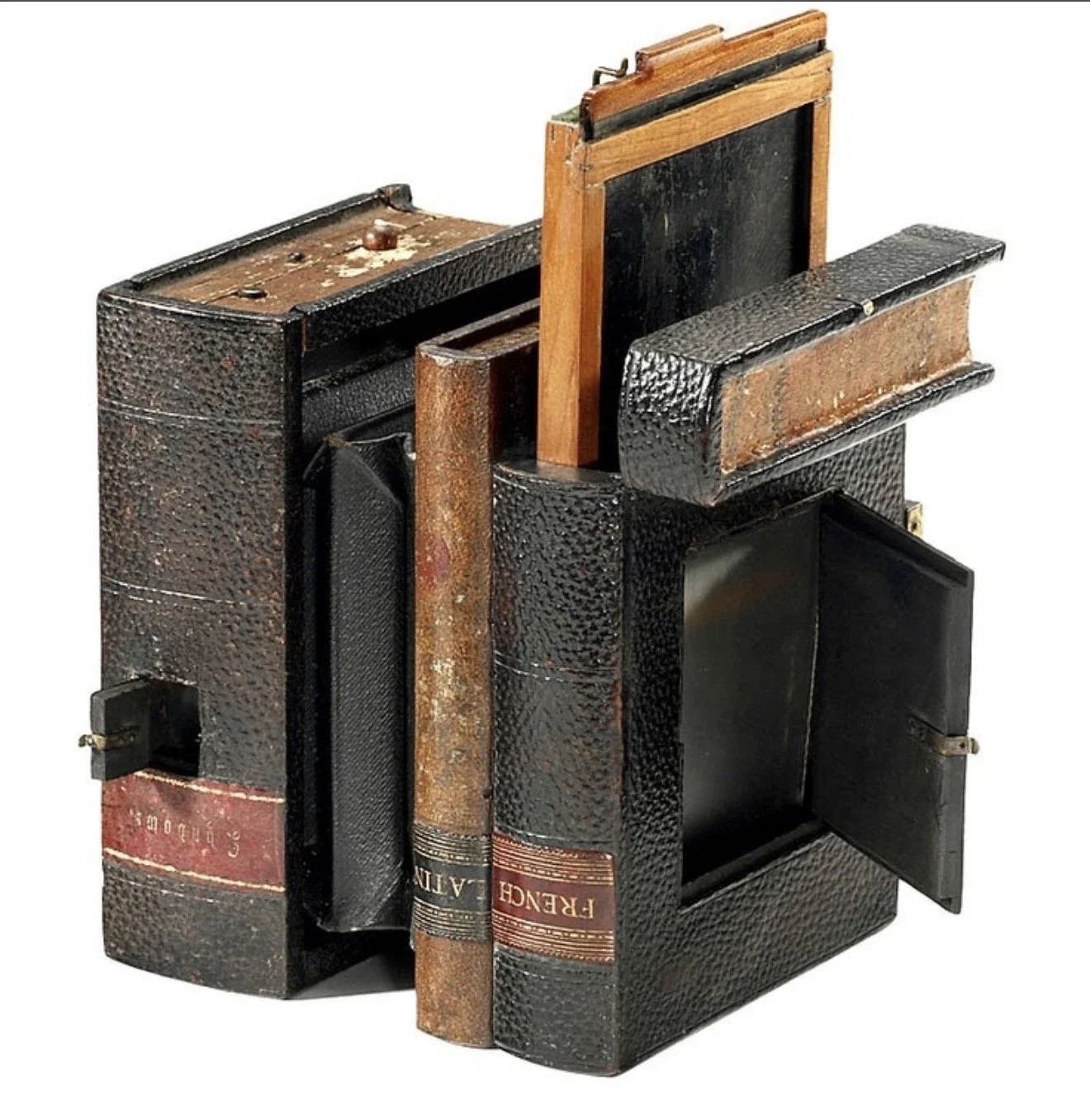
Scovill & Adams Book Camera, 1892, New York
Finding myself in a mind mix of Caroline Crampton’s Shedunnit podcast and ongoing Blog research, I have been browsing through my old detective fiction book covers to see if any featured old cameras or surveillance vibes. I somehow stumbled across the 1892 Book Camera, ‘a detective camera’, designed to look like a stack of books with a handle. Who knew this was a thing in the late 19th Century! Adverts at the time said ‘no lady or gentleman need have any fear that this parcel will attract attention as a camera for it certainly looks much unlike a camera as anything, and it is a very striking counterfeit of a parcel of three bona-fide books.’ My initial research suggests not many were made, but a few still find their way to auction.
March 2026
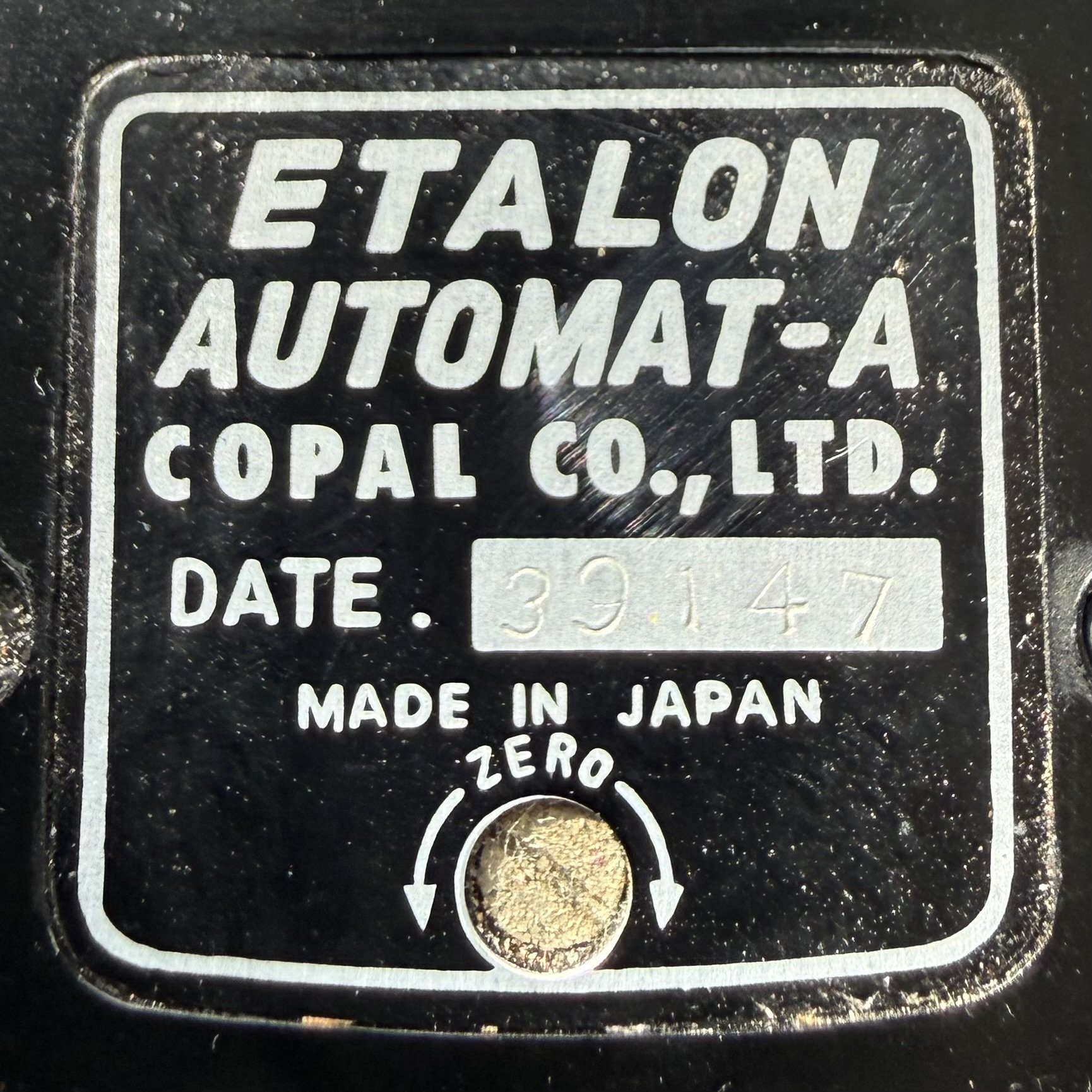
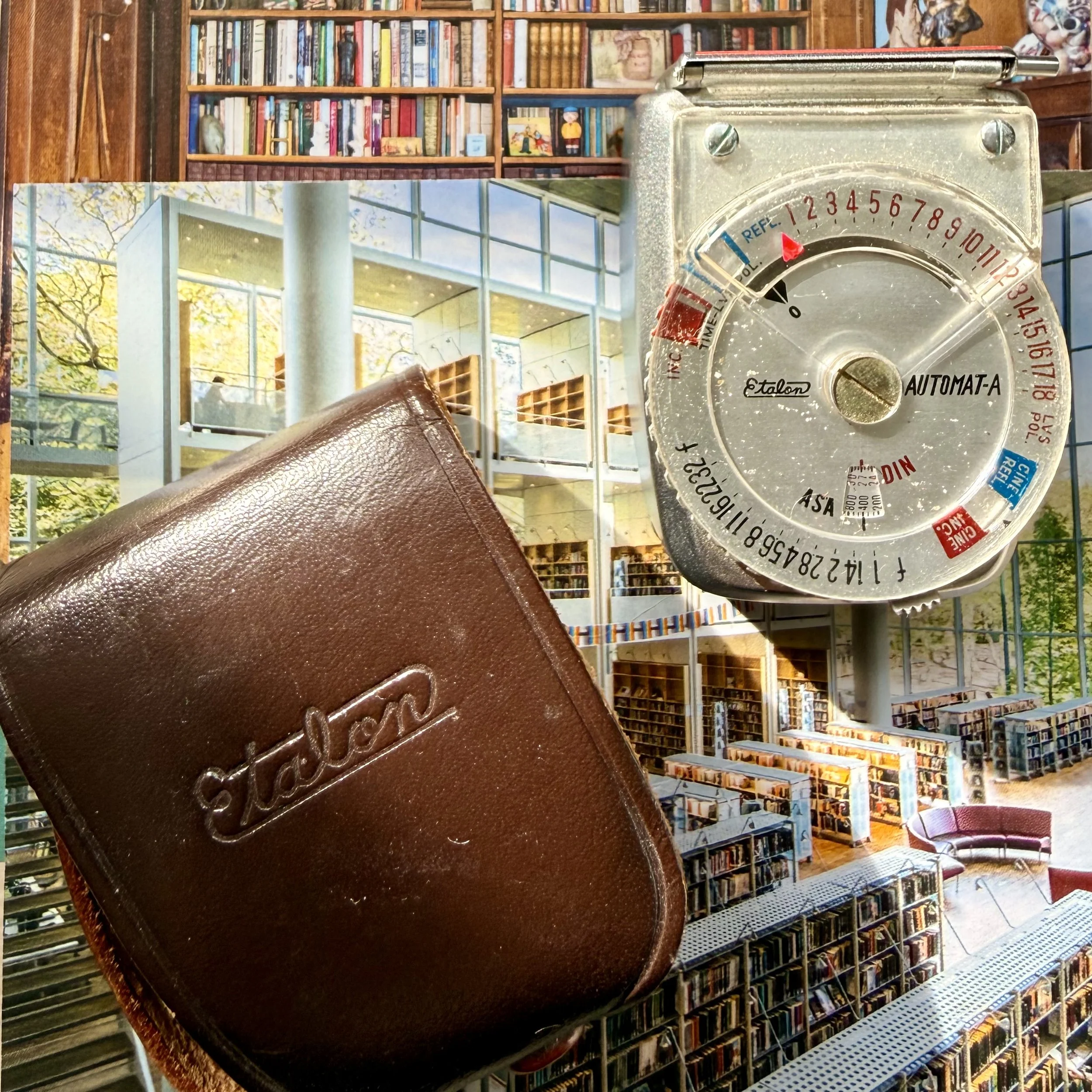
Copal Etalon Atomat-a, 1947
The Japanese Copal company made this camera light exposure meter, having started out as a very small business making camera shutters in 1946. It helps the photographer in setting the correct exposure. Powered without a battery, but with a selenium photo cell, which produces more or less electric power when exposed to more or less light. The top of the meter has a window, made of convex lenses, forming a honeycomb shape.
These light meters were an essential kit item, for the amateur and professional photographer, before built-in light metering was brought in.
March 2026
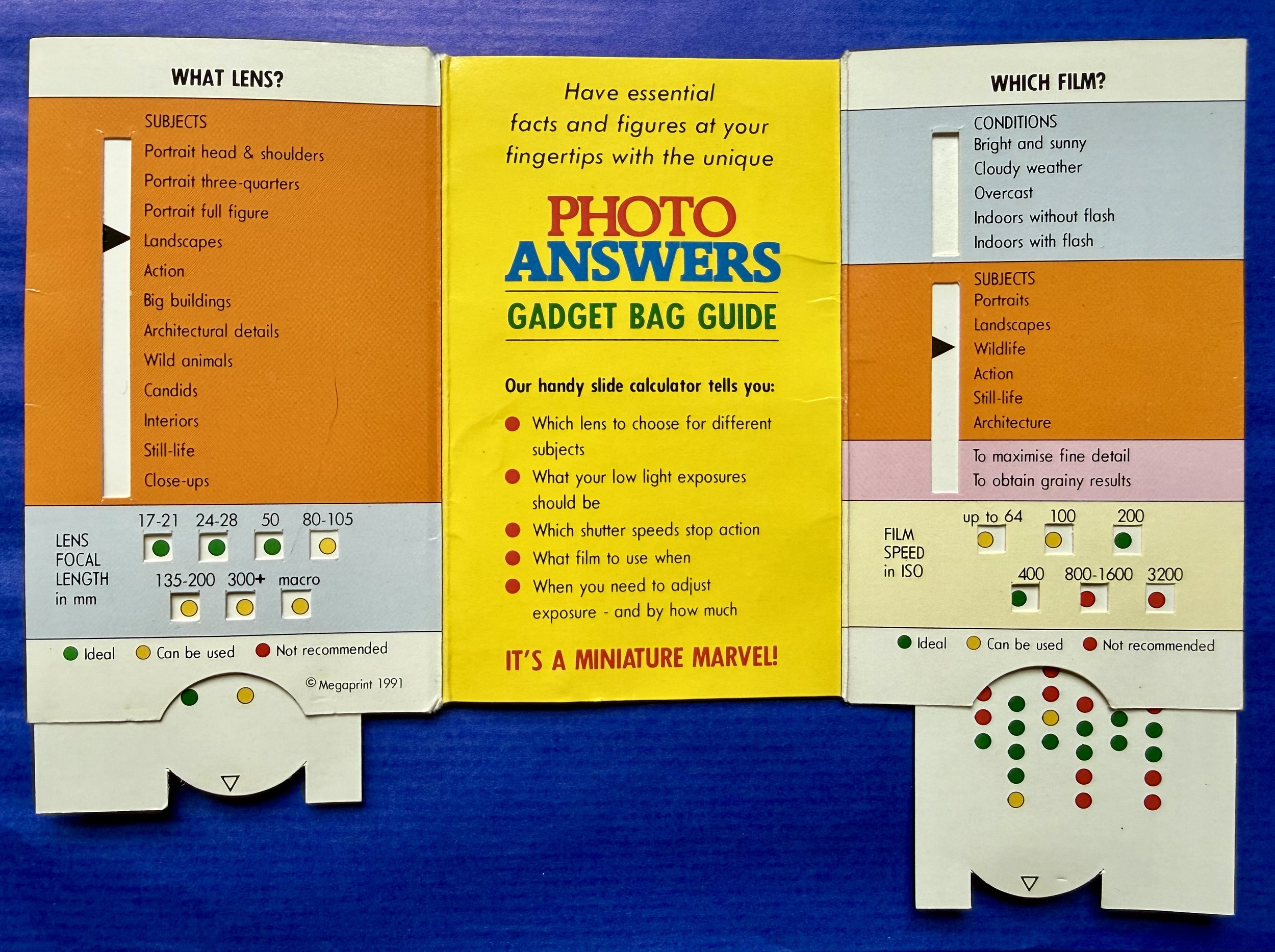
A handy slide calculator, 1991
Photo Answers Magazine produced this slide calculator in 1991. ‘IT’S A MINIATURE MARVEL’ they declared. It really is and remains a helpful guide from the camera film era, right on the cusp of the digital crossover. I think I was still using film in 1998/99 but soon after, many of us would experience our first digital compact camera.
March 2026
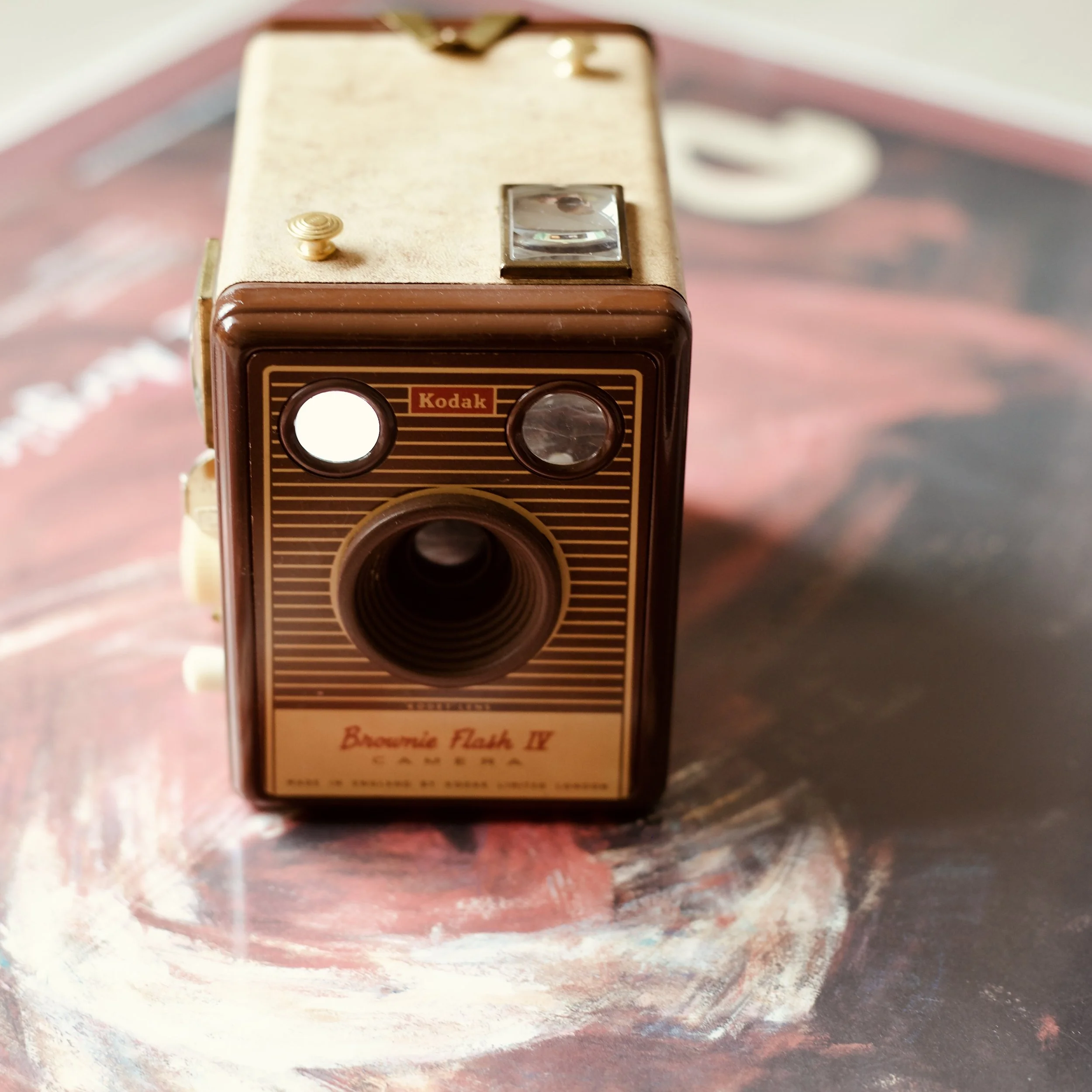
In a short break from researching the German pieces, another cabinet find reveals itself.
It’s a Brownie Flash IV, produced by Kodak between 1957-1959 in the U.K. Models didn’t last long, even then. This deluxe version features brown leatherette and gilt metal. The Brownie was first available to buy in 1900 and I didn’t know until recently that it was named after 1890s fairy/goblin-like characters, brought to life by Canadian author and illustrator Palmer Cox, based on his grandma’s stories of English and Scottish mythology. This model is often thought of as the first popular camera, easy to use, good value and a camera that brought photography to a much wider audience.
A History of Photography in 50 Cameras, by Michael Pritchard, explains that the basic box design pretty much remained the same until the 1950s, then moulded plastics were invented, lenses changed from glass to plastic and built-in or coupled flash guns for indoor shots become available. By the late 50s it was facing growing design competition and was seen as old-fashioned, but it was still the first camera for tens of millions of people and treasured (or kept in a filing cabinet!) in the decades after its heyday.
March 2026
Kodak Brownie Flash IV
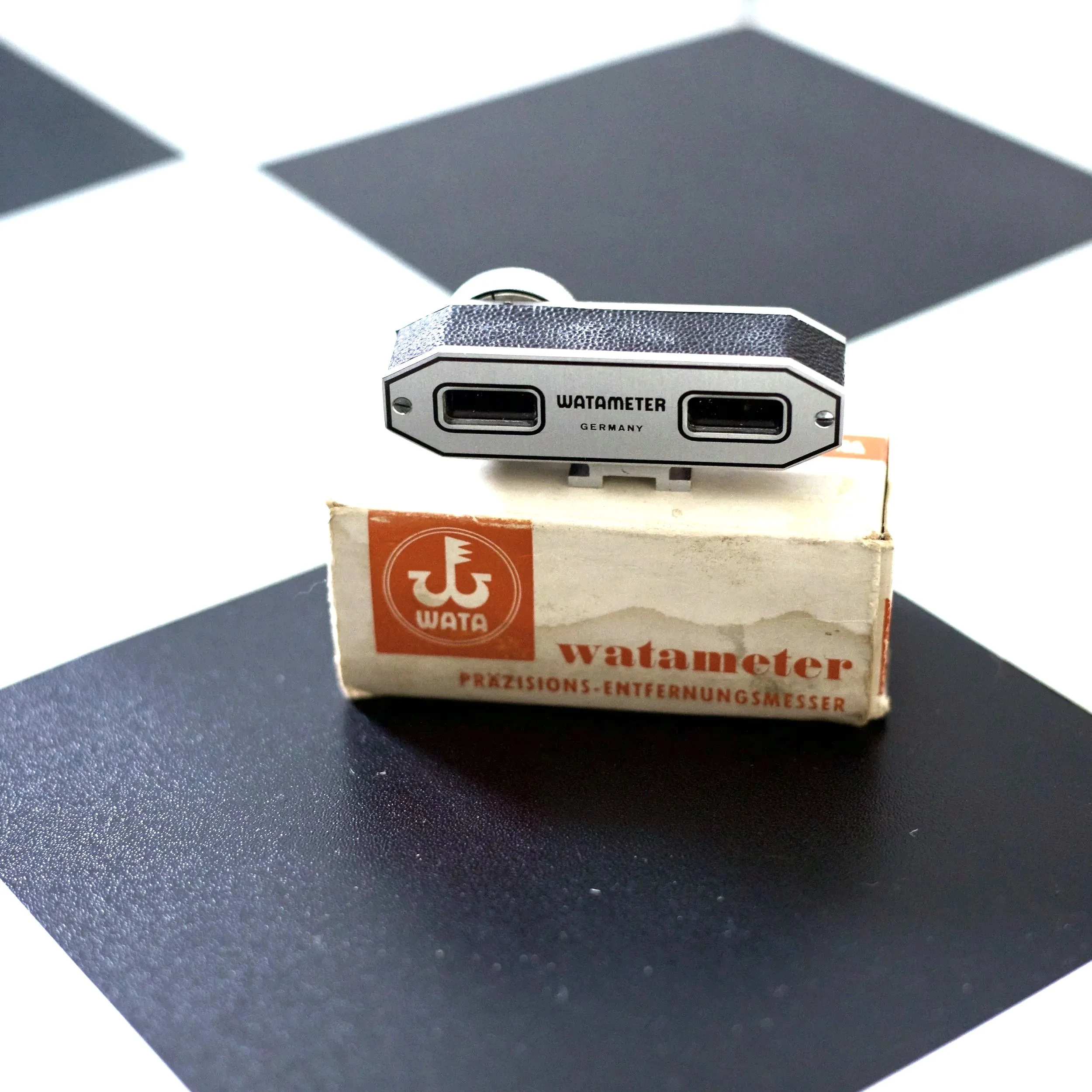
This West German 1952 Watameter rangerfinder is an unexpected find, tucked into a filing cabinet in my late parents’ house, which we’ve been clearing these last 10 months, rather sadly. Their early 1970s house held some unexpected camera-related treasures.
It has an art deco styling with metal and leatherette. Manufactured by Edmund Wateler’s company Fabrik Opt.-Fotogr. Erzeugnisse in Braunschweig, West Germany. Rangefinders were especially used from the 1930s-1960s pre the auto-focus era. The Watameter attaches to the top of the camera.
Coming into the possession of German photographic items from a friend, as well as family, has caused me to reflect. Our dad actually worked for a German company in the 80s and 90s and travelled a lot there. We briefly dabbled with migrating in the late 80s/early 90s which in hindsight would have been a transformative period to have trialled living in Germany.
This rangefinder apparently stood out from its contemporaries having an internal distance scale (appearing in the viewfinder window) and offering the ability to see distance without moving the camera away from your eyes. Its outer dial permits macro focusing from 50cm to 30cm.
March 2026
Watameter Precision Rangefinder
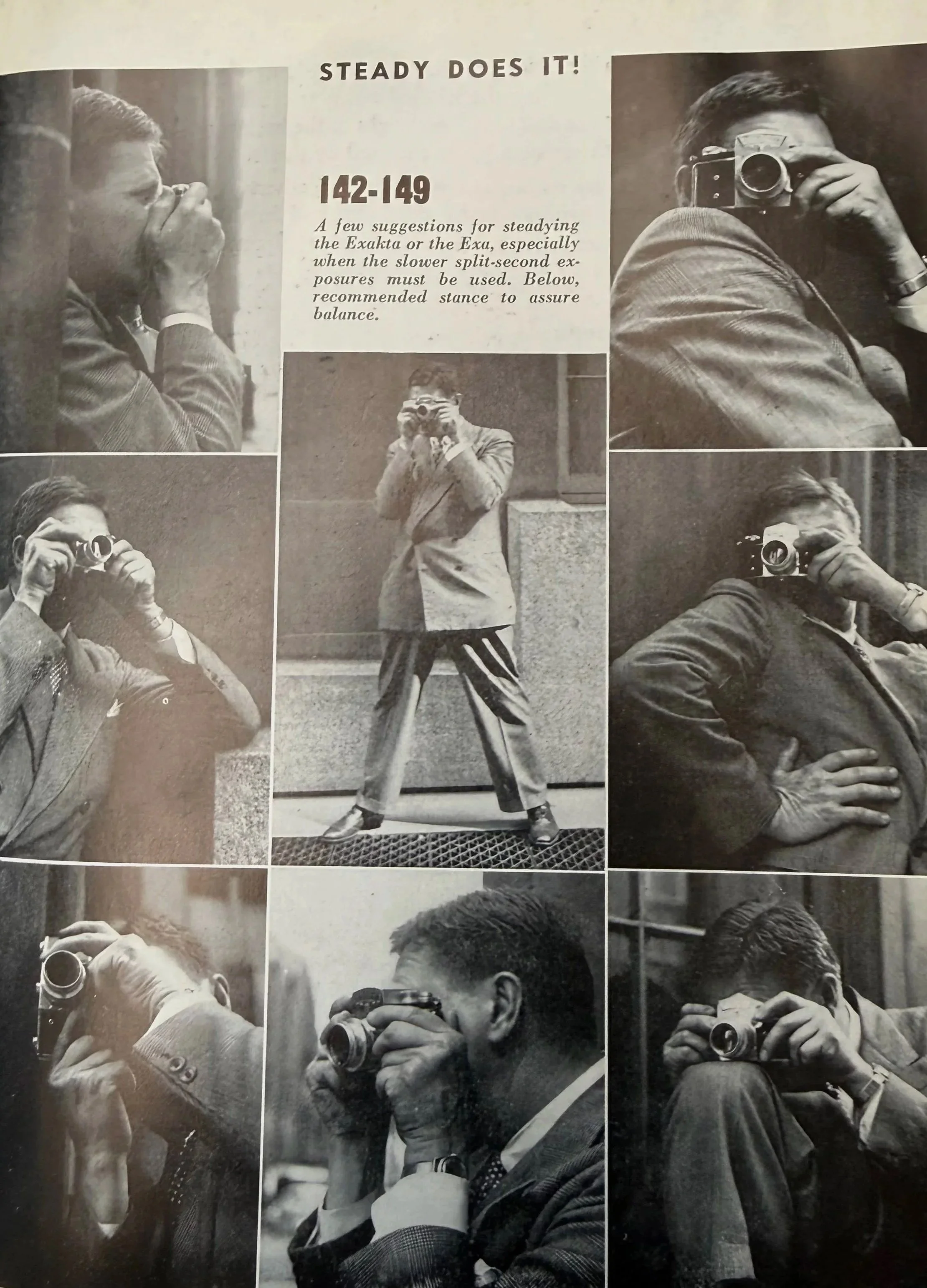
The Exakta Photography book, 1955, by Jacob Deschin has wonderful and whimsical suggestions for steadying your Exakta camera, with recommended stances perhaps worthy of spy training school.
I recently joined the V&A Museum’s National Art Library and enjoyed a visit to their Reading Room to access the Royal Photographic Society’s collection of journals, books, pamphlets and manuals. The Society has been collecting since 1853 and the Library has been housed at the V&A since 2017.
February, 2026
Steady does it! with EXAKTA
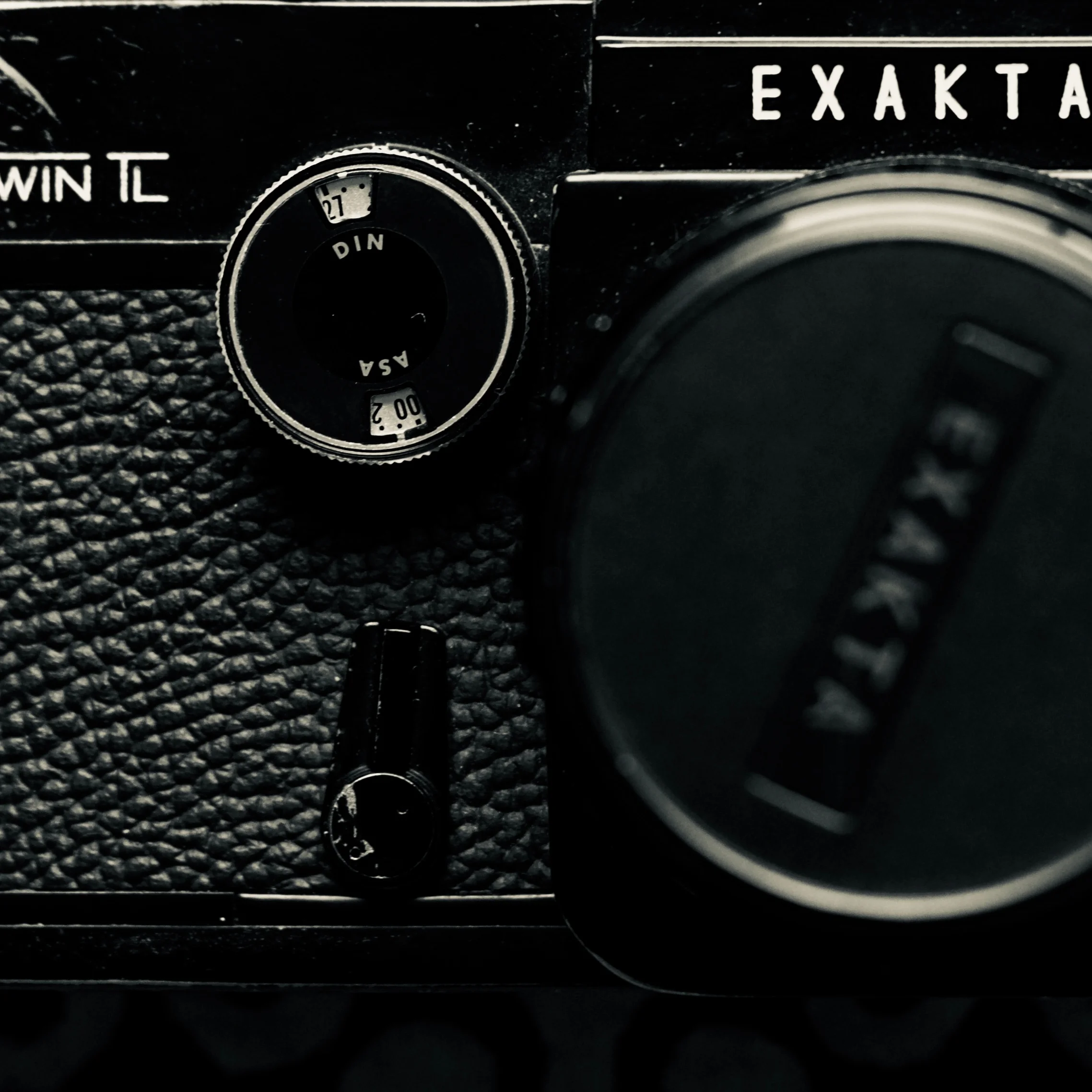
A wonderful and generous German friend (now honorary Welsh) asked if I would like to adopt her father’s camera, once a treasured piece of kit. Her father is in his 80s and is sadly no longer able to use the camera with his sight deteriorating.
Little did I know that the (West) German Exakta Twin TL is from 1970 and this model is one of the last Exaktas to be produced in East and West Germany. The Ihagee Kamerawerk company was an early experimenter with the 35mm film format (the origin of the name Exakta) and this make of camera was the first with a built-in light meter and compact single lens reflex. The original factory was in Dresden (later moving to Frankfurt and West Berlin) and for a time, Ihagee Kamerawerk was one of the largest photographic companies in the world.
It feels a little unusual and exciting to suddenly have a camera from a company with a 1912 Dutch inventor origin and a complicated history of wartime and post-war Soviet and East-West Germany ownership/brand wrangling. 1970 was also the time Germany was starting to hand over assembly to Japan with their growing competitive expertise.
The camera has a very metallic solid feel and smell, with a distinctive and satisfying mechanical soundscape, befitting of the name ‘EXAKTA’, but unfamiliar to someone growing up first using 80s compact cameras and later digital SLRs. It feels like it has had a careful and loving owner. I am certainly drawn to it, although did not realise (on initial use) that the light meter needs a tiny mercury battery! So the first photos are certainly ‘experimental’ and a little unexpectedly ethereal/ghostly.
January, 2026
The 1970 EXAKTA camera